Monday 28th April - Pangbourne to Goring
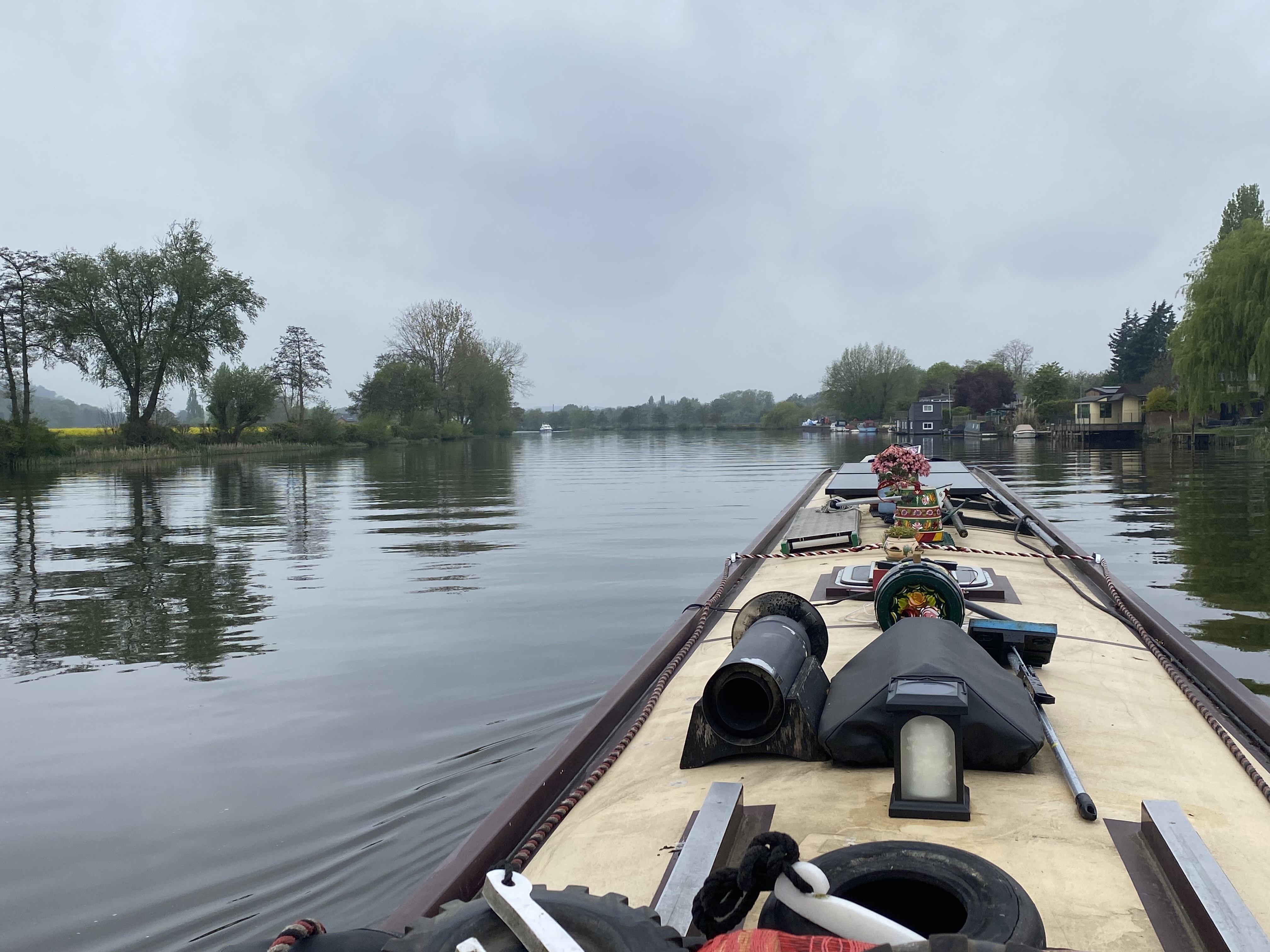
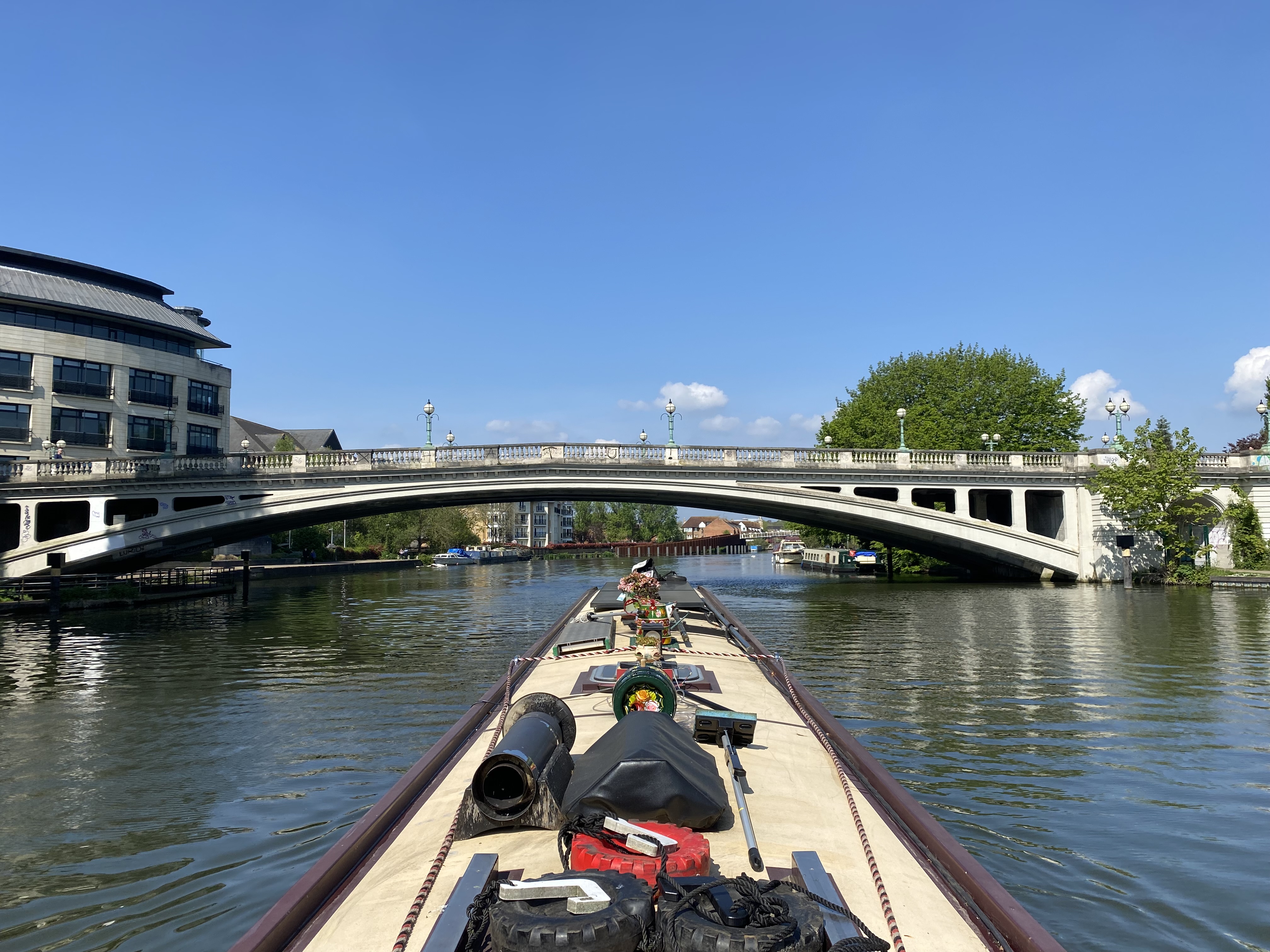
The promise of lovely sunny weather with very light winds so time to cruise!We left our mooring and headed for the lock. We passed under Whitchurch Toll Bridge. There has been a toll bridge here since 1792 and the current bridge is the fourth bridge which opened in September 2014.
On Shooters Hill there are seven Gothic-style houses known as the "Seven Deadly Sins". They were built in 1896 by the shop magnate D.H. Evans. There are alternative theories about the name "seven deadly sins". One is that they were built by D H Evans to house his mistresses, but another is that they were in fact built to house seven lady friends of the Prince of Wales (later King Edward VII).
I love this time of year as the greens are so varied, passing Child Beale we were impressed by the palate of greens on the river bank and moving up the hillside.
As we approach Goring we found the glass box hanging over the river. It was designed by the architect who did the painting of Ella when we were moored in Goring 5 years ago.
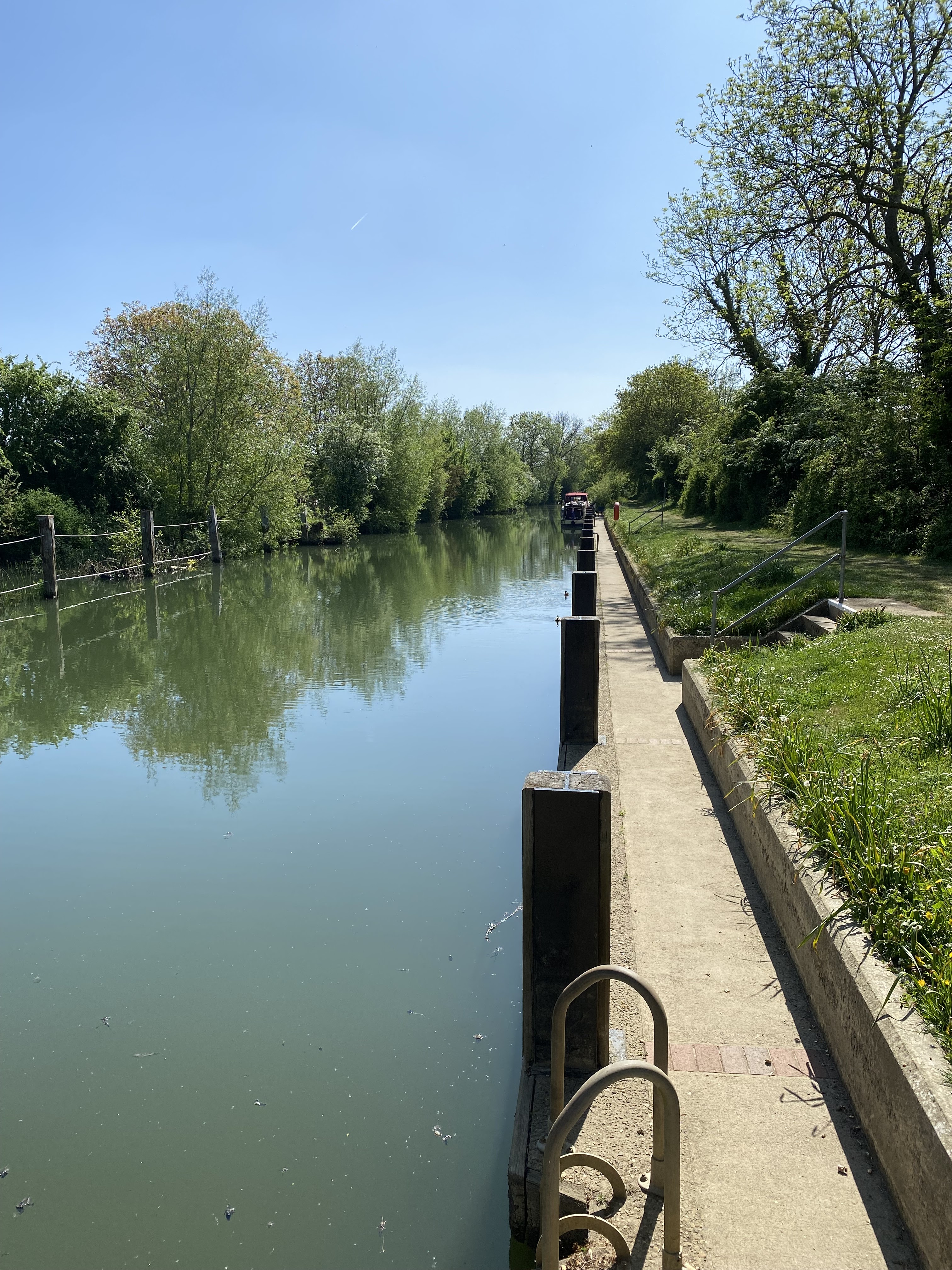
We went for a wander through Goring and then across the bridge to Streatley. This is taken from the bridge looking back at Ella on the mooring and you can see that it is incredibly quiet. By late evening we had been joined by two other boats, but that is still unusual as the moorings are generally full along here.
The church in Streatley has a blue plaque saying that Lewis Carroll, who wrote Alice in Wonderland, preached here in 1864. He stayed in the Vicarage in Vicarage Lane.
Ella in almost the exact spot where she was painted by Professor Alan Brooks back in 2019. The painting is on the wall in the apartment in Worcester.
4.25 miles, 1 lock, 1hr 42mins
Tuesday 29th April - Goring to Wallingford
Another bright sunny morning so we continued on to the next lock where we could fill up with water. The lock keeper was very helpful as he showed us where the water hose was ready for us to use. Toby is sitting in the shade of the tree watching the world go past.
On our journey up river we passed many huge riverside properties. This photo attempts to show the vast amounts of land some of these properties have, the house is way back in the distance!
Approaching Wallingford is a sign welcoming us to the town with information on where the moorings are.
We moored on the left hand side but it was a very high mooring and we struggled to get Toby on and off the boat both at the front and the back. So we shuffled across to the other side of the river where the moorings were more narrowboat friendly, moored beside the open area swimming pool which was being prepared for the summer season.
6 miles, 2 locks, 2hrs 18mins
Wednesday 30th April - Wallingford to Clifton Lock
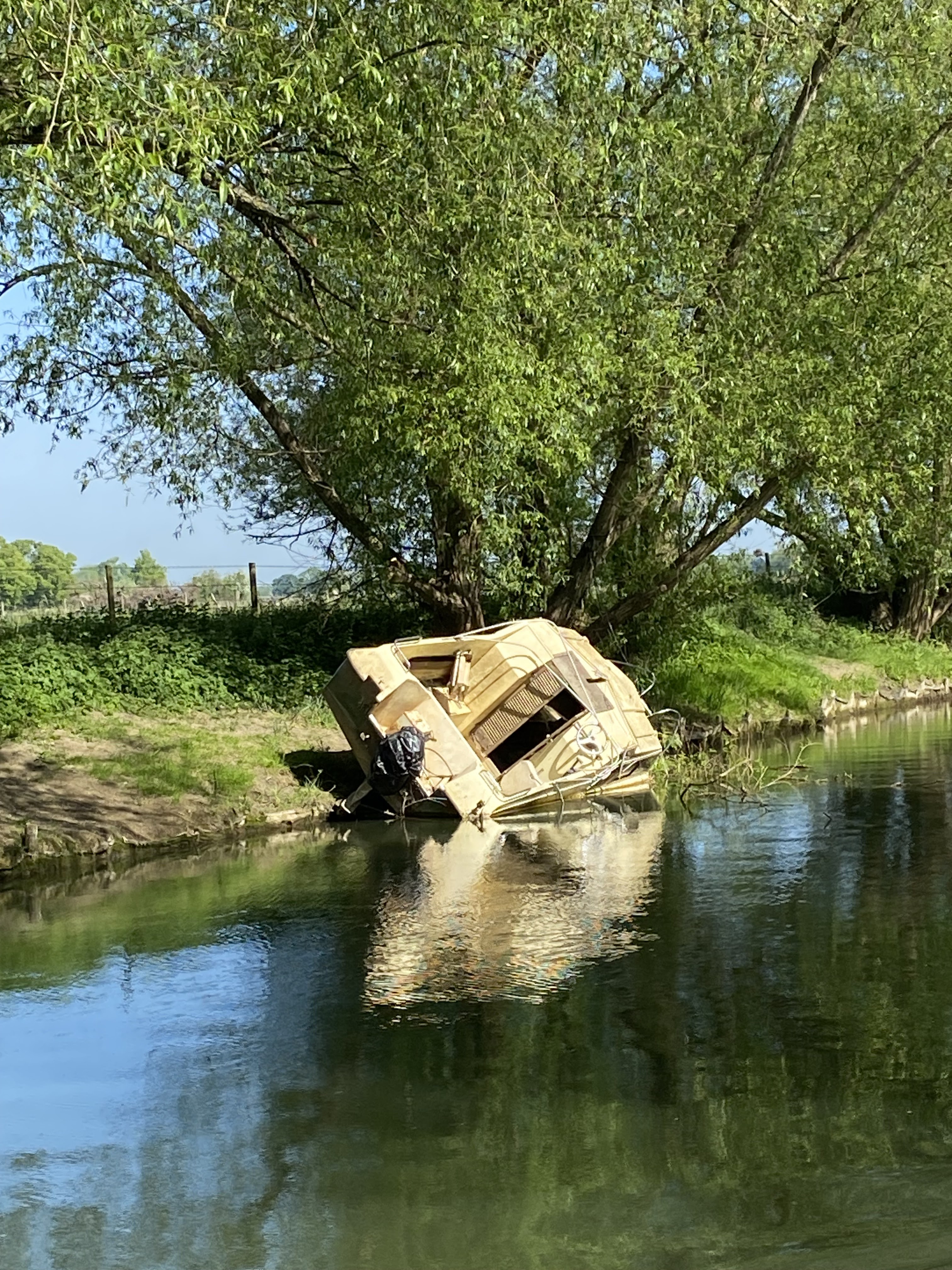
We decided to move on today and weren’t really sure where we were going to end up. We passed this boat which must have been a casualty of the river flooding. Floated up onto the bank and got stuck as the water fell again. Not sinking as such, but it would be difficult to refloat without flooding the inside.
We are heading towards Day’s Lock, with a possible mooring for the night. This is the mouth of the River Thame flowing into the Thames, down from Dorchester. It is navigable for boats with a draft of under 1ft, but not for us.
A magnificent specimen of a horse chestnut, these trees can grow up to 40m and live for 300 years. It is full of flowers at the moment. It is native to the Balkan Peninsula, first introduced to the UK from Turkey in the late 16th century and widely planted.
We came through Clifton Lock and met Curtis The Lock Keeper. He and his wife live in the lock cottage and tend the gardens. He sells cuttings from everything he grows and his hut has two large freezers full of ice cream which he also sells. We decided to stay overnight on the moorings at the far end of the lock landing.
Ella is moored at the far end of the pontoon. A wonderfully peaceful mooring, we sat out on the pontoon and even had a BBQ in the evening. We have had some delightful moorings and this has to be one of the nicest!
9 miles, 3 locks, 3hrs 57mins
Thursday 1st April - Clifton Lock to Abingdon
A short hop today to take us to Abingdon. This is one of the pumping stations linked to the Didcot Power Station before it was closed and demolished. Water would have been pumped out of the river for cooling purposes and returned to the river afterwards. The signs warning boats are still in place.
We moored up in Abingdon on the play park side, again, all very quiet with only two or three boats around. In Abingdon, temporary moorings for visiting boats are offered free of charge for a maximum stay of three nights. This policy aims to encourage boaters to visit and enjoy the town and its surroundings, while discouraging overstaying or misuse of the moorings. We decided to take full advantage of this. Bun throwing is an iconic 400 year-old tradition which is unique to Abingdon-on-Thames, when specially made buns are thrown to residents from the top of the historic County Hall in the centre of Abingdon. Bun throwings are held to mark a royal occasion and Councillors in full ceremonial robes climb to the top of the County Hall and throw several thousand currant buns down at the chanting crowds filling the Market Place below. The buns are always specially baked for the occasion and are often preserved by local families and visitors. The Abingdon County Hall Museum has a selection of buns from previous bun throwings throughout the years and there is even a local cafe named after the tradition with old newspaper clippings and pictures on the walls.
4.25 miles, 1 lock, 2hrs 6mins
Friday 2nd May - Abingdon
Abingdon Abbey was probably founded in the late seventh century, but its great days started when it was re-founded by Bishop Aethelwold and the Wessex kings about 950. It remained one of the foremost of the English abbeys, and at the dissolution of the Monasteries under Henry VIII its income was assessed as the sixth largest in the country. At that time it was probably the greatest landowner in the county of Berkshire, and also held property in many other parts of the country. The Abbey church was of a size and splendour comparable to any of the great cathedrals. Nothing of it remains, but its outline is marked out on the ground in the Abbey Gardens. These ruins in the Abbey Gardens are Trendell's Folly, built in the nineteenth century.
Toby relaxing in the cool of the rear of the boat.
Saturday 3rd May - Abingdon to Sandford
A lovely morning and we watched the weekly Park Run set off on the opposite side of the river. It was very well attended with a large crowd of runners and supporters. We then set off for the lock and stopped above the lock to fill with water and dispose of all rubbish.
We had a good journey to Sandford Lock only to find that all the moorings were full. The lock keeper was very helpful and offered us the mooring on the other side of the lock behind the Environmental launch. It was a little tricky, we had to reverse the boat through wooden poles, passed other moored boats and then tuck in behind the launch. The river was quite silted up so we could only go so far back and the bow of our boat had to be moored beside the launch. A celebratory shandy, well earned!
Ella on her mooring, tucked in behind the Environmental Launch. Despite being opposite the pub, we weren’t disturbed at all, possibly due to the rapid fall in temperatures!
5 miles, 2 locks, 2hrs 24mins
Sunday 4th May - Sandford to Oxford
A much colder day, we had to go back to long trousers and winter coats as the wind was really very cold! Saying goodbye to Sandford Lock and our last mooring on the river for this trip. It has been a brilliant experience and we’ve enjoyed every minute but I am looking forward to getting back to canals and smaller locks!
Ella in Isis Lock, the first narrow lock of this trip. The cruise to here was very good although a little windy coming through Oxford and all the twists and turns. We also had to negotiate a novice rowing boat of 4 rowers, who were struggling to keep their boat in a straight line, and managed to collide with another boat whilst we watched!
We moored on the canal and after some lunch we went for a walk into Oxford along Walton Street. This is the Radcliffe Observatory. The Radcliffe Observatory is a historical landmark and Green Templeton College’s centrepiece. Meteorological records commenced here in 1772, and for almost 200 years this listed building served as the only astronomical observatory of the University of Oxford (1773-1934). The Observatory has been used since as a medical research facility, a teaching centre and now a hub for the college.
Hertford Bridge, better known as the Bridge of Sighs, is a famous bridge in Oxford. Heralded for its uniquely striking design, the bridge has become a landmark for sightseers. Completed in 1914, this beautiful bridge acts as a link between two Hertford College buildings. This bridge symbolically links the old and new quads of Hertford College.
The Bodleian Library is one of the oldest libraries in Europe, and in Britain is second in size only to the British Library. Together, the Bodleian Libraries hold over 13 million printed items. The Bodleian Library has been a library of legal deposit for 400 years.
The Radcliffe Camera is an iconic Oxford landmark and a working library, part of the central Bodleian Library complex. It is linked to the Bodleian Old LIbrary by the underground Gladstone Link. The Radcliffe Camera is home to the History Faculty Library (HFL). The Radcliffe Camera is one of the most celebrated buildings in Oxford. Instantly recognizable, its great dome rises amid the Gothic spires of the University. Dr John Radcliffe was the most successful physician of his day. On his death in 1713 he directed that part of his large fortune should be used to build a library on a site at the heart of Oxford, between the University Church of St Mary's and the Bodleian. The Radcliffe Camera is a great rotunda surmounted by Oxford's only dome, an architectural masterpiece and Britain's first circular library.
We ended up in the Turf Tavern for a drink. Its foundations and use as a malt house and drinking tavern date back to 1381. The low-beamed front bar area was put in place sometime in the 17th century. It was originally called the Spotted Cow but the name was changed in 1842, as part of an effort to extinguish its reputation as a venue for illegal gambling activities. It also features in the TV series Inspector Morse.
4.5 miles, 3 locks, 2hrs 30mins